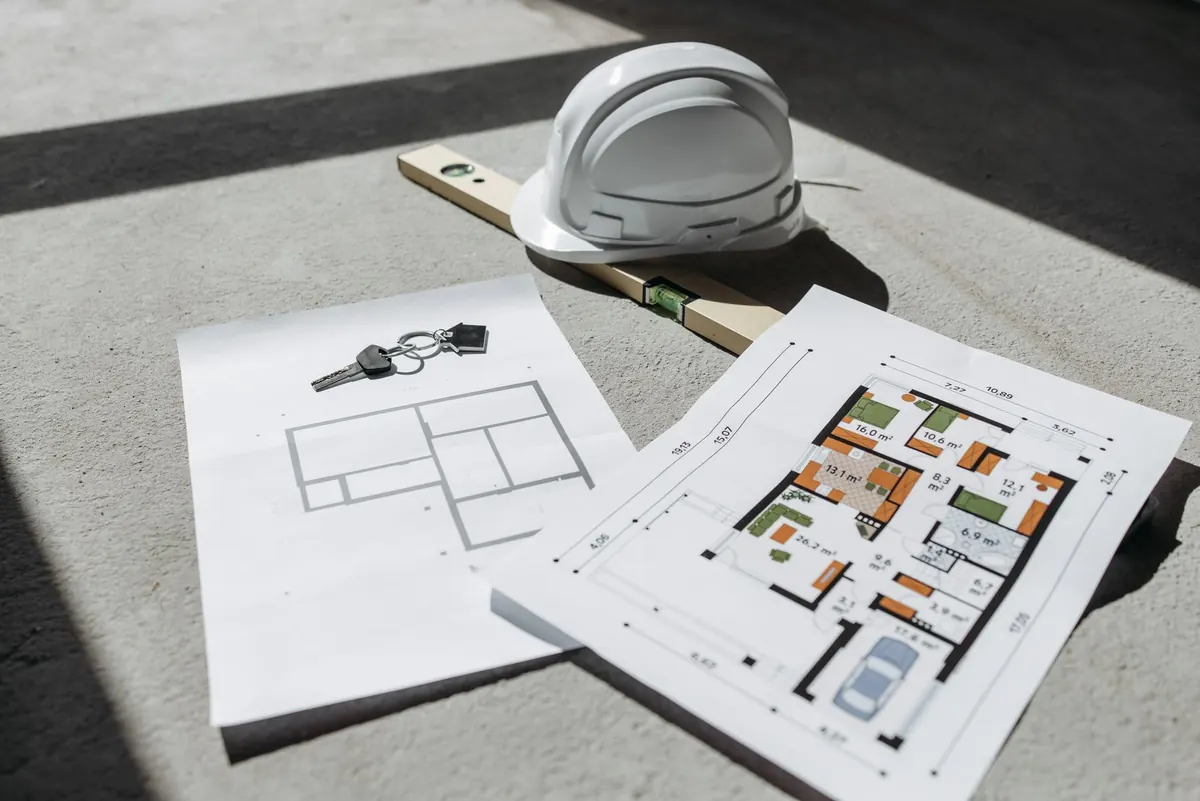
The laminated notice on the lamppost had been there a week before anyone on the street read it properly. Rain had worked in under the plastic, and the deadline was printed in a font size meant for people with excellent eyesight. It announced an application for nine flats on the site of a closed garage, with comments closing in eleven days. A neighbour asked whether it was already decided. It wasn't. The file was open, the drawings were online, and nobody had looked at them.
Planning notices are public documents, but they are written for readers who already understand the process. Ten minutes in the right order changes what you can say, and how much of it will land.
What a planning notice actually tells you
A notice is an advertisement. It exists to tell the world that an application has been submitted to the local planning authority, and it is a legal requirement in most cases. That is all it is. It is not a decision, a vote on whether your area should change, or a consultation on the principle of development in general. It concerns one proposal on one site, described in one sentence.
Not every notice covers a straightforward planning application. Some advertise listed building consent, works to protected trees, advertisement consent, a change of use, or a scheme that departs from the adopted development plan. The reading rules are the same. If a copy came through your door, it usually means you are an immediate neighbour, but there is no private version of the information: the notice on the fence and the entry in the council's register say the same thing.
Where notices appear, and how to get to the file
Councils are required to publicise applications in more than one place, and in practice the notice is often the weakest link. Look in these places:
- On or near the site — a post at the boundary, a fence, a lamppost. Easy to miss, sometimes removed, occasionally never put up.
- The council's planning register online — search by application reference, by address, or on a map. This is where the real file lives.
- The local newspaper — some categories of application still have to be advertised in print.
- Parish or town council noticeboards, libraries and community centres.
- Ward councillors and residents' associations, who often hear about a scheme before the paperwork appears.
If a notice mentions an application you cannot find online, call the planning department, quote the reference and ask for the case officer. Portals go down, and references get mistyped. A two-minute call beats an evening of guessing which application is which.
Reading the notice, line by line
The text is short because it makes no attempt to explain itself. Work through it in this order:
- Application reference — a string of letters and numbers. Save it in your phone. Quote it in every email you send.
- Site address — check it carefully. Sites straddle boundaries and often carry several addresses.
- Description of development — the line that matters most, covered below.
- Applicant and agent — the agent is the firm handling the paperwork. Write to the case officer, not to the applicant.
- Type of application — full, outline, reserved matters, variation or removal of conditions, listed building consent, change of use.
- Deadline for comments and how to submit them: portal, email or post.
- Case officer and contact details — the person who will actually read what you write.
The description line
Slow down here. "Erection of up to nine dwellings with associated access, parking and landscaping" is doing a lot of quiet work. "Up to" is a ceiling, not a promise of fewer. "Associated" conceals the parts you care about: the parking, the bin store, the new junction. "Outline" means the principle is being decided now, with layout, scale and appearance to follow at a later stage, so comment on the principle and the access while you can. "Reserved matters" is that later stage, and it is a genuine second chance to shape details. "Variation of conditions" usually means an approved scheme is being altered, sometimes substantially, on far less paperwork than a fresh application.
Then note what is missing. No mention of drainage, delivery hours, bin collections, or how many bedrooms each unit has. Absence is often the strongest material for a comment, because somebody has to answer it in writing.
What is in the documents, and what to open first
The register entry usually has a documents tab with dozens of files, and the instinct is to close it immediately. Read in this order instead:
- The planning statement or design and access statement — the applicant's own explanation and justification. Start with the first five pages.
- The location plan and block plan — where the buildings sit relative to your boundary.
- Elevations and floor plans — heights, window positions, distances between walls.
- The transport or parking statement — vehicle numbers, access arrangements, trip estimates.
- Drainage, flood risk, trees, ecology, heritage — whichever apply to the site.
- Consultation responses from statutory bodies such as highways, drainage and conservation. These frequently flag problems before residents do.
Download the drawings rather than skimming them on screen. Applications get amended, and revised plans carry a new date and version number. If you object to a drawing that has since been replaced, your point is quietly answered by default and counted as resolved.
Comment periods, and how to write something that counts
The length of the comment period varies by council and by the type of application, and extensions do happen. The date printed on the notice governs, so check the portal rather than assume, and give yourself a couple of days of margin.
What usually counts as a material consideration: overlooking and loss of privacy, daylight and sunlight, noise and disturbance, traffic safety, parking pressure, drainage and flooding, scale and design, heritage, ecology, and consistency with local plan policies. What generally does not: loss of a private view, the effect on your property's value, competition with an existing business, or your view of the applicant.
A structure that works:
- Your name, address and the application reference.
- Whether you support or object, in the first sentence.
- Numbered points, each tied to something in the file: "The first-floor window shown on the east elevation faces our kitchen at a distance of roughly eight metres."
- What would resolve each point — a screen, a condition, a revised layout, a different access point.
- A page if you can manage it. Case officers read hundreds of these.
Supportive comments carry weight too, and a stack of identical letters carries less than twenty distinct, specific arguments. If your concern is legal rather than planning — a boundary, a covenant, a right of way — that is a separate matter, and it is worth taking professional advice rather than folding it into a planning comment.
A short checklist for the next two weeks
- Note the reference and the deadline, and set a reminder two days early.
- Print the site plan and stand at your boundary with it.
- Read the first five pages of the design and access statement.
- Write your points as they occur to you, with rough measurements.
- Submit through the portal and keep the acknowledgement.
- Check the portal after the deadline for revised drawings and the officer's report.
After comments close, the case officer writes a report and most applications are decided under delegated powers; larger or contentious ones go to a planning committee, where residents can sometimes register to speak. The decision notice and the officer's report are published afterwards, and the report is the most useful document of the lot: it tells you which points were considered and why. Keep the habit of checking the register once a month, and most of what happens on your street will reach you long before the scaffolding does.
Photo: Pavel Danilyuk / Pexels